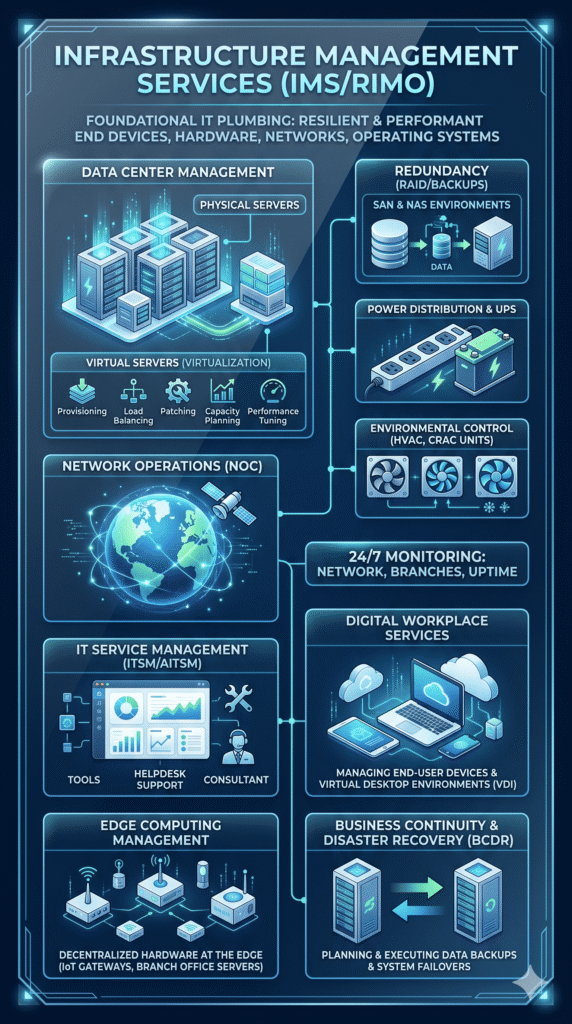
Infrastructure Management Services (IMS/RIMO)
This category focuses on the foundational plumbing of IT environment—ensuring that End Devices, hardware, networks, and operating systems are resilient and performant.
- Data Center Management: Monitoring and maintaining physical or virtual servers, storage, and power.
This is the core of computing power. Management here focuses on ensuring that applications have the horsepower they need to run smoothly.
- Physical Servers: This involves Rack and stack, maintenance. Engineers monitor hardware health (CPU temps, fan speeds, power supply status) and handle lifecycle tasks like installing new blades, upgrading RAM, and maintaining.
- Virtual Servers (Virtualization): Most modern data centers run on hypervisors (like VMware or Hyper-V). Management involves:
- Provisioning: Spinning up new Virtual Machines (VMs) instantly.
- Load Balancing: Moving VMs between physical hosts to ensure no single server is overworked.
- Patching: Updating Operating Systems without taking down the entire service.
- Capacity Planning: Monitoring how much space is left and predicting when more disks will be needed so you don’t run out of “closet space” for your data.
- Performance Tuning: Ensuring that high-demand databases are on fast Flash/SSD storage, while older archives sit on cheaper, slower disks (Tiered Storage).
- Redundancy (RAID/Backups): Ensuring that if a drive fails, the data isn’t lost. This includes managing SAN (Storage Area Networks) and NAS (Network Attached Storage) environments.
- Power Distribution: Managing PDUs (Power Distribution Units) and ensuring that high-density racks don’t trip breakers.
- Uninterrupted Power Supply (UPS): Maintaining the massive battery arrays and diesel generators that kick in if the local grid fails.
- Environmental Control: Monitoring HVAC and CRAC (Computer Room Air Conditioning) units. This includes managing “Hot Aisle/Cold Aisle” containment to ensure cold air goes into the servers and hot air is sucked out efficiently.
Bottom Line: Data Center Management is the art of balancing performance (speed) with resilience (staying online) while keeping costs (power/hardware) under control.
- Network Operations (NOC): 24/7 monitoring of Network, Branches and Uptime.
- IT Service Management (ITSM/AITSM): Tools, Helpdesk support, Consultant.
- Digital Workplace Services: Managing end-user devices (laptops, mobile) and virtual desktop environments (VDI).
- Edge Computing Management: Managing decentralized hardware at the edge (e.g., IoT gateways, branch office servers).
- Business Continuity & Disaster Recovery (BCDR): Planning and executing data backups and system failovers.