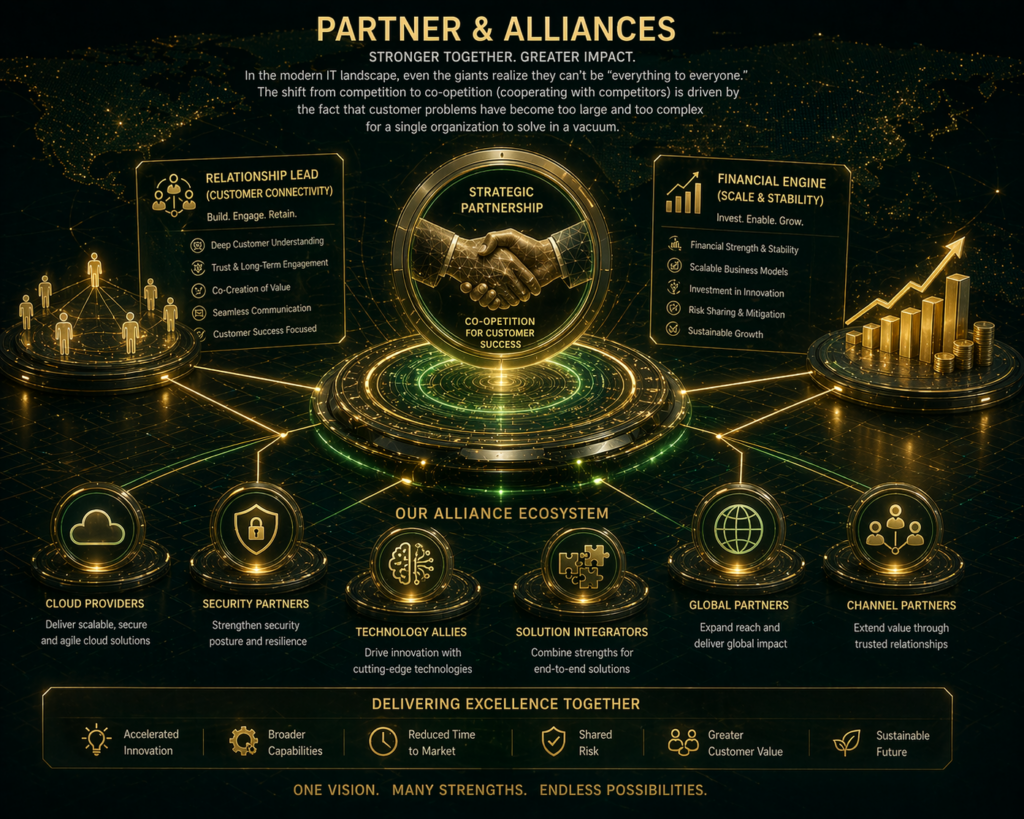
Partner and Alliances
- Partnering with other IT services for end to end delivery –
- Deep trust, cultural alignment, and “boots on the ground” presence with the client.
- A global tech giant might have the best software, but a local boutique firm understands the client’s internal politics, legacy headaches, and specific industry regulations. Relationship Lead opens the door and ensures the solution fits the client’s actual culture.
- Niche, black-belt knowledge in a specific technology (e.g., a firm that only does a solution in Cybersecurity for BFSI).
- Generalists are great for maintenance, but for high-stakes transformations (like migrating a core banking system to the cloud), you need the people who live and breathe that specific code.
- A track record of we’ve done this 100 times before.
- Technical knowledge is different from execution. An organization with delivery experience brings the blueprints, the project management frameworks, and the knowledge of where things usually go wrong. They provide the stability to the project.
- Balance sheet to handle massive upfront costs, hardware procurement, and long-term liability.
- Many brilliant tech start-ups have the expertise but lack the cash flow to sustain a multi-crore, multi-year contract. By partnering with a financially “heavy” firm, the client gets the innovation of the small firm with the financial insurance of the large one.
- Partner A (Global System Integrator): Provides the financial backing and project management.
- Partner B (AI Boutique): Provides the custom algorithms (Technical USP).
- Partner C (Regional Consultant): Handles the local data privacy laws and user training (Customer Connectivity).
- Why OEM Partnerships are Critical
- Access to Roadmap & “Inside Track”: Partnerships give service providers early access to beta features and product roadmaps. This allows them to prepare clients for shifts in technology before they happen.
- Specialized Support & Escalation: When a critical system goes down, a “Gold” or “Platinum” partner has a direct line to the OEM’s advanced engineering teams. This drastically reduces downtime for the client.
- Cost Optimization: OEMs provide partners with better pricing, incentives, and “market development funds” (MDF). These savings are often passed to the client or used to fund proof-of-concept (PoC) projects.
- Certified Expertise: OEM programs require rigorous training and certification. For a client, an OEM badge is a “seal of trust” that the provider actually knows how to configure the hardware or software correctly.
- Ecosystems for delivering Outcomes to Customer
- Complexity Management: Modern IT environments are hybrid and multi-cloud. No single OEM provides everything. An ecosystem allows a service provider to stitch together Azure (Cloud), CrowdStrike (Security), and ServiceNow (Operations) into one seamless fabric.
- Interoperability: By building an ecosystem, service providers ensure that the different “parts” of the IT stack actually talk to each other. They test the integrations so the client doesn’t have to.
- One-Stop-Shop Experience: Clients want a single point of accountability. If the service provider has a robust ecosystem, they can manage the entire lifecycle—from procurement and deployment to 24/7 support—regardless of how many vendors are involved.
- Innovation at Speed: When a provider has a broad ecosystem, they can “plug and play” new technologies (like generative AI modules) into existing frameworks much faster than building from scratch.