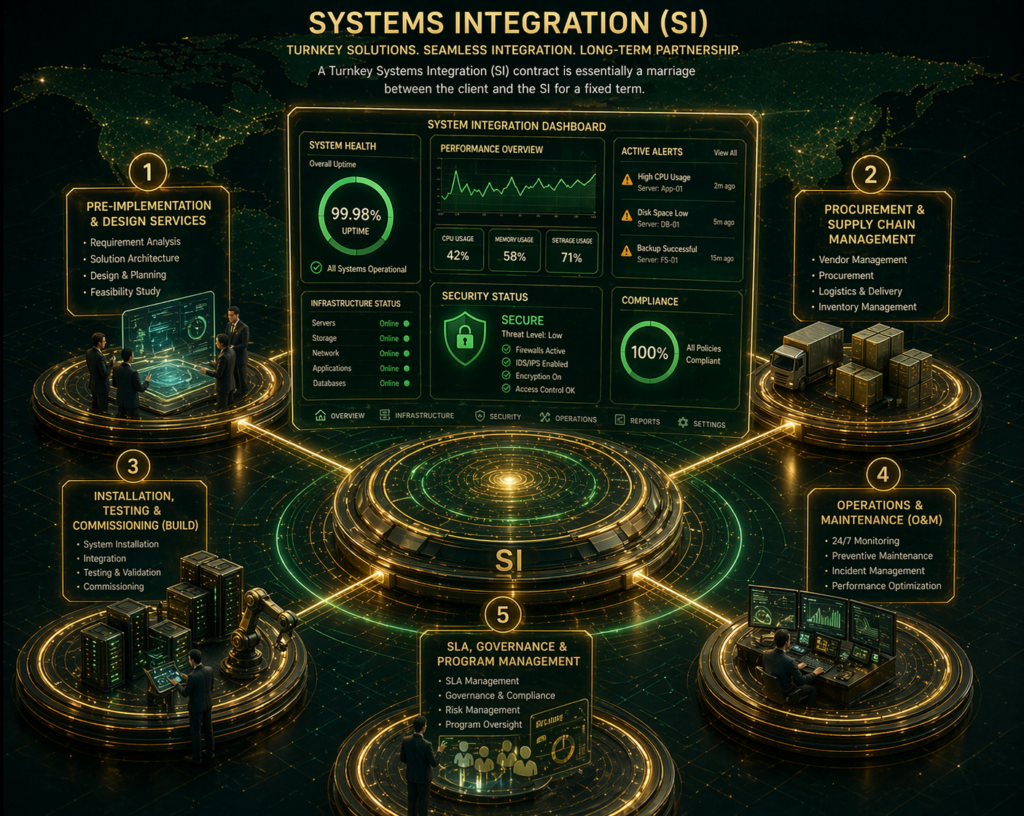
Systems Integration (SI)
A Turnkey Systems Integration (SI) contract is essentially a marriage between the client and the SI for a fixed term (usually 5 years). The SI takes on the Single Point of Responsibility (SPR), ensuring that if any part of the tech stack fails, there is only one neck to choke.
1. Pre-Implementation & Design Services
- Detailed Project Report (DPR) & Design: Finalizing the High-Level Design (HLD) and Low-Level Design (LLD) for the entire ecosystem.
- Site Readiness Audit: Assessing the physical sites (Data Centers, branch offices) for power, cooling, earthing, and physical security.
- Bill of Material (BoM) Validation: Verifying that the hardware and software quoted will actually deliver the required performance at peak Indian scale.
- Strategic Sourcing: Procurement of all IT hardware (Servers, Storage, Laptops) and Non-IT hardware (UPS, Precision ACs, Fire Suppression).
- Licensing Management: Handling the complexity of perpetual vs. subscription licenses and ensuring compliance with Indian tax laws (GST).
- Logistics & Staging: Managing the movement of gear to remote Indian locations (Tier-2/Tier-3 cities) and staging (pre-configuring) it at a central hub.
- Stack & Rack: Physical installation of hardware in the Data Center or Command Center.
- Install and Implement: Hardware, Software, Networking and Security implementation.
- Customization & Localisation: Tailoring software interfaces and customizations.
- User Acceptance Testing (UAT): Running stress tests and get the Go-Live certificate from client.
- Managed NOC & SOC: 24/7 monitoring of the network and security via a dedicated operations center.
- Facility Management Services (FMS): Deploying “Resident Engineers” on-site at the client’s office for immediate hands-on support.
- Preventive & Corrective Maintenance: Regular “health checks” on hardware and software to fix issues before they cause downtime.
- Patch & Version Management: Ensuring all systems are updated to the latest secure versions without breaking the integration.
- Asset Lifecycle Management: Tracking the warranty and “End of Life” (EoL) status of thousands of components.
- SLA Reporting: Monthly dashboards proving that the 99.9% uptime (or whatever was promised) was met.
- Penalty & Incentive Management: Deliver and do CSI.
- Change Management: Managing Scope Creep—when the client wants new features added mid-way.
- Knowledge Management: ITIL based service Delivery